Todd County Dog Registration Information
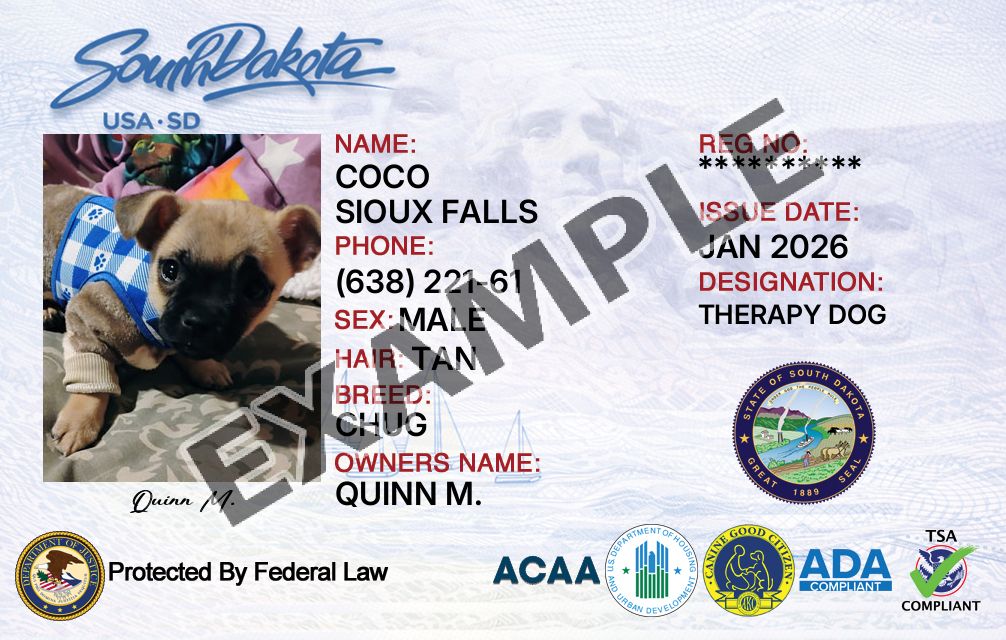
Service Dogs and Emotional Support Animals in Todd, South Dakota
Registering a Dog in Todd County, South Dakota (Service Dog or Emotional Support Dog)
If you’re searching where do i register my dog in Todd County, South Dakota for my service dog or emotional support dog, the most important thing to know is this: a dog’s “license/registration” is a local animal-control or public-health process, while a service dog (under the ADA) is defined by training and disability-related work or tasks—not by a registry card.
This page explains how a dog license in Todd County, South Dakota is typically handled, what offices to contact first, what rabies documentation is usually involved, and how licensing differs from service dog and emotional support animal (ESA) rules.
Where to Register or License Your Dog in Todd County, South Dakota
Because licensing and enforcement are often handled locally, here are example official government offices that can usually direct you to the correct process for where to register a dog in Todd County, South Dakota—including questions about rabies documentation, animal control, and local ordinances.
Example Official Offices (Start Here)
| Office | Contact & Address | Hours |
|---|---|---|
Todd County SheriffLocal law enforcement / may direct animal-control or nuisance enforcement questions
|
Address: 315 Lincoln Street, Mission, SD 57555-1038
Phone: 605-856-4411
Email: toddco@gwtc.net
Tip: Ask who issues dog tags/licenses (county, city, or other local authority) and who handles rabies bite quarantine orders for your area.
|
Not listed
|
South Dakota Animal Industry Board (State Veterinarian / Rabies guidance)State-level rabies prevention and guidance (not a local dog-licensing office)
|
Phone: 605-773-3321
Use for rabies prevention questions, exposure guidance for animals, and referrals to appropriate state/local contacts.
|
Not listed
|
South Dakota Department of Health (Rabies information)Public health rabies information (human exposure guidance)
|
Main phone: (605) 773-3361
Email: DOH.info@state.sd.us
For questions about rabies risk and human exposure guidance; local enforcement still typically runs through local officials.
|
Not listed
|
Rosebud Sioux Tribe Game Fish and Parks (Department contact)Tribal government department contact (may direct to the right tribal office for animal-related enforcement where applicable)
|
Phone: 605-856-2146
If you live in a community served by tribal government services, ask which office handles animal control, rabies enforcement, and any dog licensing/tagging requirements.
|
Not listed
|
Overview of Dog Licensing in Todd County, South Dakota
Dog licensing is usually local (not a “service dog registry”)
In many South Dakota communities, a dog license (sometimes issued as a tag) is a local requirement tied to animal control, nuisance enforcement, and public health practices. That means the process for a dog license in Todd County, South Dakota can depend on where you live (for example: within a particular community’s local rules versus county-level enforcement practices).
If you’re registering a service dog or an emotional support dog, you generally still start with the same “pet” steps for licensing (if your local area requires licensing): keeping rabies vaccinations current, maintaining identification, and following leash and control ordinances. The legal status of a service dog under the ADA is a different topic than whether your local authority issues a license tag.
Rabies vaccination expectations and why they matter
Rabies prevention guidance in South Dakota emphasizes keeping pets vaccinated, avoiding contact with wildlife acting abnormally, and reporting concerns to local animal control or authorities. Rabies can be spread through bites and other exposure routes, and prevention focuses heavily on vaccination and minimizing exposure risks.
Practically, local licensing (where required) commonly ties directly to rabies vaccination records. Even when a community doesn’t issue a formal license tag, rabies vaccination proof is often the key document requested after a bite incident or when reclaiming a stray dog.
How Dog Licensing Works Locally in Todd County, South Dakota
Step 1: Confirm the correct local authority for your address
When people ask where to register a dog in Todd County, South Dakota, the real first step is identifying who actually administers the requirement where you live. Depending on your location, you may be directed to:
- a county office or county-contracted enforcement point,
- a local community office that issues tags or handles animal complaints,
- a law enforcement office that coordinates animal-control enforcement,
- and, in some areas, a tribal government office that handles local animal regulations.
If you call and describe your community and street location, ask: “Who issues dog licenses/tags here, and what proof is required?” Also ask: “Who enforces rabies quarantine or bite reporting for this area?”
Step 2: Prepare documents (rabies record is the most common)
Local requirements vary, but the most common documents requested for a license or registration record include a current rabies vaccination certificate (or proof from a veterinarian), plus basic owner identification. Some areas may also ask for proof of residency and a licensing fee (if local rules require it).
Step 3: Understand what a local dog license does (and does not do)
A local dog license/tag typically helps authorities:
- confirm the dog is associated with an identifiable owner,
- encourage rabies vaccination compliance,
- support reunification if a dog is found stray,
- support enforcement in nuisance, roaming, or bite incidents.
A license/tag generally does not determine whether a dog is a service dog under federal law and it does not turn a pet into an emotional support animal. Those statuses come from entirely different legal frameworks.
Service Dog Laws in Todd County, South Dakota
Service dog status is based on training and disability-related tasks (not registration)
Under the Americans with Disabilities Act (ADA), a service animal is generally a dog that is trained to do work or perform tasks for a person with a disability. This is why there is usually no single official “service dog registration” that you must complete for public access—your dog’s role is defined by training and function, not a card or certificate.
What businesses can ask you (the ADA “two questions” rule)
If it is not obvious what service your dog provides, ADA guidance explains that staff may ask only two questions:
- Is the dog a service animal required because of a disability?
- What work or task has the dog been trained to perform?
This is separate from local licensing. In other words, even if you obtain a dog license in Todd County, South Dakota (if required locally), a business generally should not treat that license as the test for whether your dog is a service animal.
Service dog licensing vs. local dog license
Many handlers still keep their dog’s rabies vaccination current and follow local rules, even when the dog is a service animal. A local dog license (if required) is a local compliance step. ADA service-dog access rights are a federal civil rights framework. These can overlap in daily life, but they are not the same thing.
Emotional Support Animal Rules in Todd County, South Dakota
An ESA is not the same as a service dog
An emotional support animal (ESA) provides therapeutic support related to a mental health disability, but it is not automatically a “service dog” under the ADA for public access in stores, restaurants, or other public accommodations. ESAs are most commonly addressed in the context of housing accommodations rather than broad public-access rights.
Housing accommodations vs. dog licensing
If your main goal is an ESA accommodation in housing, the process typically centers on documentation supporting the disability-related need for the animal (as applicable under housing rules). That is different from where to register a dog in Todd County, South Dakota, which is usually a local licensing/animal control question tied to rabies compliance and local ordinances.
Even as an ESA, local rabies and control rules still apply
Whether your dog is a pet, an ESA, or a service dog, you should still expect local requirements related to rabies vaccination, leash/control rules, and responding appropriately to any bite incident or quarantine instruction issued by the appropriate authority.
Frequently Asked Questions
Answer
ADA service dog status is generally not created by registration. However, you may still need to follow any local requirements for a dog license in Todd County, South Dakota (if your local jurisdiction issues licenses/tags) and keep rabies vaccination records current. If you’re unsure, contact the local offices listed above and ask who handles licensing for your exact address.
Answer
A local dog license is a local compliance record (often tied to rabies vaccination and animal control). A “service dog ID card” is not required under the ADA for public access. Service dog access rights come from the dog being trained to perform disability-related tasks and the handler meeting ADA criteria—not from a purchased card or listing.
Answer
Requirements vary, but commonly include rabies vaccination proof, identification, proof of residency, and a licensing fee (if your local authority charges one). If an office cannot license you directly, ask them to point you to the correct local authority for animal control dog license Todd County, South Dakota questions.
Answer
Typically, no. ESAs are generally addressed under housing accommodation rules rather than broad public-access rules under the ADA. That’s why “ESA registration” is different from where to register a dog in Todd County, South Dakota for licensing purposes.
Answer
Start with the Todd County Sheriff’s Office contact listed in the office section and ask who administers dog licensing/tags and rabies enforcement for your exact address. If you are directed to a different local office, write down the department name and ask what documentation and fees apply.
Register A Dog In Other South Dakota Counties
Select your county below to get started with your dog’s ID card. Requirements and license designs may vary by county, so choose your location to see the correct options and complete your pup’s registration.
- Aurora County Dog Registration
- Beadle County Dog Registration
- Bennett County Dog Registration
- Bon Homme County Dog Registration
- Brookings County Dog Registration
- Brown County Dog Registration
- Brule County Dog Registration
- Buffalo County Dog Registration
- Butte County Dog Registration
- Campbell County Dog Registration
- Charles Mix County Dog Registration
- Clark County Dog Registration
- Clay County Dog Registration
- Codington County Dog Registration
- Corson County Dog Registration
- Custer County Dog Registration
- Davison County Dog Registration
- Day County Dog Registration
- Deuel County Dog Registration
- Dewey County Dog Registration
- Douglas County Dog Registration
- Edmunds County Dog Registration
- Fall River County Dog Registration
- Faulk County Dog Registration
- Grant County Dog Registration
- Gregory County Dog Registration
- Haakon County Dog Registration
- Hamlin County Dog Registration
- Hand County Dog Registration
- Hanson County Dog Registration
- Harding County Dog Registration
- Hughes County Dog Registration
- Hutchinson County Dog Registration
- Hyde County Dog Registration
- Jackson County Dog Registration
- Jerauld County Dog Registration
- Jones County Dog Registration
- Kingsbury County Dog Registration
- Lake County Dog Registration
- Lawrence County Dog Registration
- Lincoln County Dog Registration
- Lyman County Dog Registration
- Marshall County Dog Registration
- McCook County Dog Registration
- McPherson County Dog Registration
- Meade County Dog Registration
- Mellette County Dog Registration
- Miner County Dog Registration
- Minnehaha County Dog Registration
- Moody County Dog Registration
- Oglala Lakota County Dog Registration
- Pennington County Dog Registration
- Perkins County Dog Registration
- Potter County Dog Registration
- Roberts County Dog Registration
- Sanborn County Dog Registration
- Spink County Dog Registration
- Stanley County Dog Registration
- Sully County Dog Registration
- Tripp County Dog Registration
- Turner County Dog Registration
- Union County Dog Registration
- Walworth County Dog Registration
- Yankton County Dog Registration
- Ziebach County Dog Registration